
— Termite control
Termite Control in Rosenberg, TX
Inspection-first termite control for slab homes in 77471 and 77469. We confirm which termite you have, show you where it’s active, and give you a written plan and price before any treatment.
How do you get rid of termites in Rosenberg?
Termite control in Rosenberg starts with an inspection of the slab, the brick ledge and every spot where wood touches soil. Once the species and the active areas are confirmed, the colony is treated with a non-repellent liquid termiticide around the foundation, a termite bait system, or both.
Spraying the swarmers you can see won’t stop the colony feeding. Treating the soil and the colony will. That’s how good pest control in Rosenberg handles termites.
— Identify it
Which Termites Are in Rosenberg?
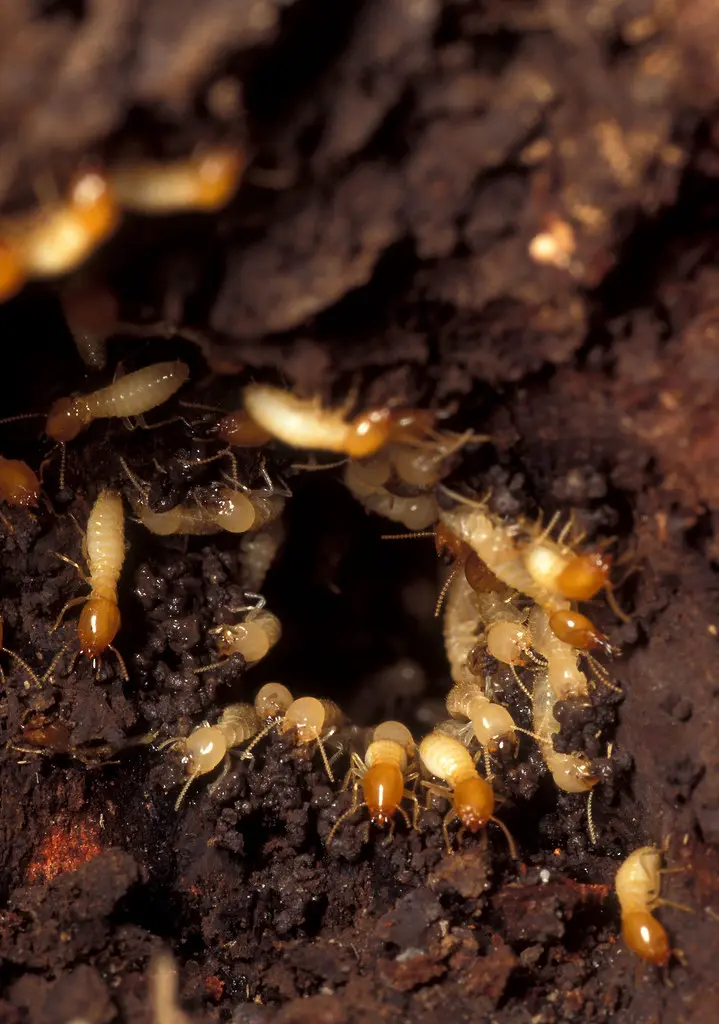
Two groups cause most of the damage in Fort Bend County: native subterranean termites and the invasive Formosan subterranean termite. Texas A&M ranks the Formosan termite among the most aggressive and economically damaging termites in the United States.
| Native subterranean termite | Formosan subterranean termite (Coptotermes formosanus) | |
|---|---|---|
| When they swarm | Late winter through spring | Late spring to early summer. Texas A&M AgriLife puts it around May 15 to June 15, most around June 1 |
| Time of day | Daytime | Dusk and night, drawn to porch lights and lit windows |
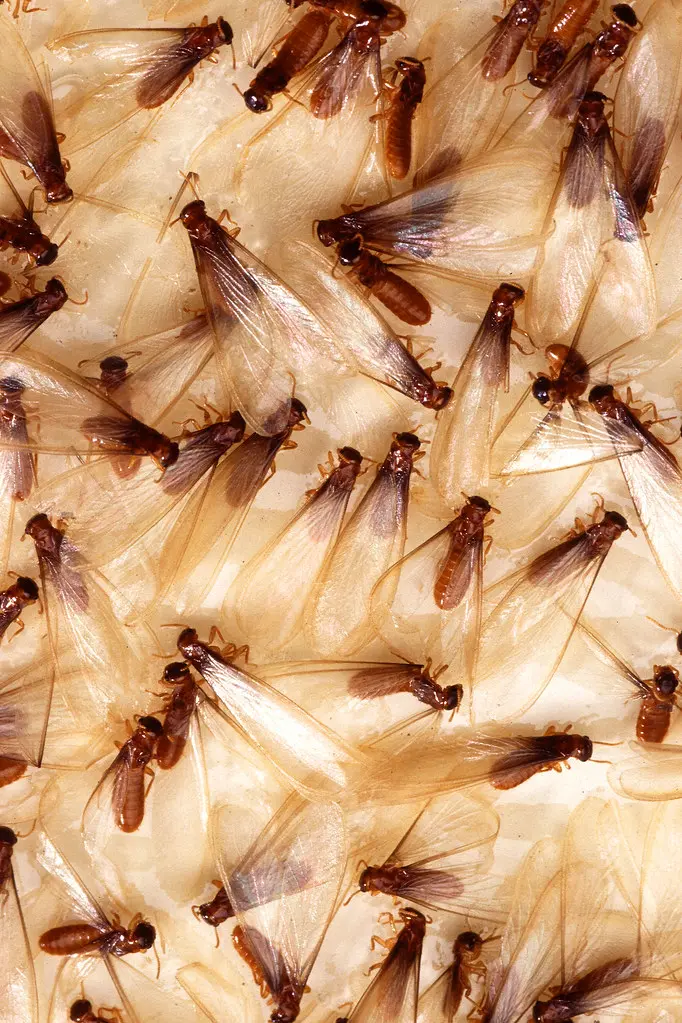
| Swarmers | Coal black to yellow-brown, about 1/4 to 3/8 inch | Often appear in large numbers around lights |
| Soldier head shape | More rectangular | Teardrop or egg-shaped |
| Colony | Smaller colonies, slower damage | Much larger colonies, faster damage. Can build above-ground “carton” nests |
| Found in Fort Bend County? | Yes | Yes. First found in Texas in 1956 near the Houston Ship Channel and since detected in 31 Texas counties |
Signs of termites in a Rosenberg home
Flying ants or termites?
Termite swarmers have straight antennae, a thick waist and two pairs of wings of equal length. Flying ants have bent antennae, a pinched waist and front wings longer than the back ones.
Not sure? Save a few in a zip-top bag and show us. If they turn out to be ants, our ant control page covers what to do next.
— Local conditions
Why Termites Are a Problem in Rosenberg
Termite pressure here comes from the soil, the climate and the way homes are built.
Why do termites swarm around my porch light in May?
That’s the Formosan swarm. Formosan termites fly at dusk and at night in late spring, and they head straight for lights. Rosenberg is close enough to the Houston area, where these swarms are reported every year around Mother’s Day.
Turn off outdoor lights during swarm evenings and keep blinds closed on lit windows. Then book an inspection, because a swarm nearby means a mature colony nearby.
Are the old railroad ties in my yard a termite risk?
They can be. Texas A&M says infested wood such as railroad ties and landscape timbers is thought to be the main way Formosan termites spread in Texas, and creosote treatment often doesn’t reach the core of these timbers.
Rosenberg grew up as a railroad town, so used ties and old timbers turn up in a lot of yards. If yours are in contact with soil near the house, have them checked during the inspection.
How do termites get into a slab home?
Through gaps you can’t easily see. Subterranean termites travel in mud tubes from the soil to wood, and on a slab home that means cracks, plumbing penetrations, expansion joints and the seam where a driveway or patio meets the foundation.
Brick veneer and weep holes add more hidden paths up to the framing. That’s why we check the full perimeter, not just the spot where you saw damage.
Does a new home in Rosenberg still need termite protection?
Yes. New sections like Brookewater and Sendero are built on freshly graded land, and fresh mulch beds against the foundation keep the soil moist, which termites like.
Ask your builder what pre-construction treatment was done and when. We can review that during the inspection.
Seeing swarmers or mud tubes? Call (281) 549-0821 for a termite inspection.
— Our process
Our Termite Treatment Process
Every termite job follows the same five steps, and Texas Department of Agriculture rules shape several of them.
1
Inspect
A technician walks the whole structure and checks every place termites use to reach wood. Slab homes have no crawlspace, so the work is at the perimeter, the flatwork and the attic.
2
Identify
We confirm native or Formosan, and whether activity is current or old. This decides the treatment.
3
Plan in writing
Texas rules require a termite proposal to include a diagram of the areas to be treated, the approximate perimeter measurement and the areas of active or previous activity. You get the price at the same time.
4
Treat
Usually a non-repellent liquid termiticide applied by trenching around the foundation, with drilling through slabs and flatwork where needed. A termite bait system with monitoring is the other option, alone or combined.
5
Record and follow up
After treatment, Texas rules require a sticker by the water heater, breaker box or under the kitchen sink showing the company, applicator license number, product and date. We check back on bait systems and come back if activity returns.
— Slab inspection
What We Check on a Rosenberg Slab Home
Termite damage usually stays hidden until it’s serious, which is why our Rosenberg pest control technicians inspect instead of guessing. On a typical Rosenberg brick-and-slab home, the technician checks:
— Treatment options
Liquid Treatment or Bait Stations: Which Fits Your Home?
Both are proven. The right choice depends on where the termites are, how your slab and flatwork are laid out, and how much ongoing maintenance you want. We’ll explain the trade-offs for your home instead of selling one answer.
| Liquid termiticide | Termite bait system | |
|---|---|---|
| How it works | A non-repellent liquid is applied to the soil around the foundation. Termites pass through it and carry it back | Stations around the home are monitored, and bait is placed where termites feed |
| On a slab home | Trenching at the perimeter, with drilling through slabs and flatwork where needed | No drilling. Stations go in the soil around the house |
| Upkeep | Companies typically say a liquid treatment lasts around five years | Needs ongoing monitoring and annual maintenance |
| Best fit | Active infestations that need a strong soil barrier quickly | Homes where drilling is hard, or as added protection |
Texas rules also allow treating less than the whole structure if you ask for it and the product label permits. We’ll tell you plainly what that does and doesn’t protect.
How to prepare
— Timeline
How Long Does Termite Treatment Take?
A liquid barrier is usually applied in a single treatment visit, after the inspection and your written plan.
Bait systems take longer to work, because termites have to find the bait and carry it back to the colony. They also need ongoing monitoring.
Don’t expect every swarmer to vanish overnight. Swarmers don’t eat wood, and leftover wings or a few late fliers are normal in the days after treatment.
— Cost
How Much Does Termite Control Cost in Rosenberg?
These are Houston-area averages, the nearest published data for Rosenberg. They are not our prices. Every pest control Rosenberg TX quote we give starts with a free inspection.
| Service | Houston-area average | Source |
|---|---|---|
| Termite elimination | $250 to $1,000 | Angi, Houston (updated Aug 2026) |
| Subterranean termite treatment | $245 to $1,480 | Fixr, Houston |
| Termite inspection | About $75 to $150 | Fixr, Houston |
| Liquid treatment, standard | $3 to $4 per linear foot | Thumbtack, Houston |
| Liquid treatment, drilling or foaming through slab | $4 to $5 per linear foot | Thumbtack, Houston |
Our price for your home comes from a free inspection, in writing, before any work starts. No surprise add-ons. See how our pricing works.
What changes the price
Get your termite price in writing before any work starts.
— What you can do
What You Can Do Yourself
You can make your home less attractive to termites. You can’t reliably eliminate an established subterranean colony with store products.
Texas A&M AgriLife’s advice if termites swarm in or around your home: don’t panic, learn your options, and don’t let anyone rush you into buying termite services. We agree.
— Scope
What’s Included, and What’s Not
Termite work is its own TDA license category, separate from general pest control, so a general pest control plan doesn’t cover termites. We also don’t treat lawn pests or wildlife. See what we don’t treat.
— Service area
Termite Control Across Rosenberg
We inspect and treat homes throughout Rosenberg in 77471 and 77469, from the older buildings of Historic Downtown to new construction in Brookewater and lake neighborhoods like Bonbrook Plantation. We also serve nearby Richmond, Pecan Grove, Sugar Land and Fulshear. See all areas we serve. Learn more about our local team, providing pest control in Rosenberg for 15+ years.
— FAQ
Termite Control FAQ
Still have a question?
Talk to a local exterminator. We answer 24/7.
— Contact us
Book a Termite Inspection in Rosenberg
Tell us what you’re seeing. We’ll confirm whether it’s termites, show you where they’re active, and give you a written plan and price. No pressure and no obligation.
Request a free inspection
No pressure and no obligation.
We’ll call you back within 1 hour.