
How Is Pest Control Done? Step by Step, Pest by Pest

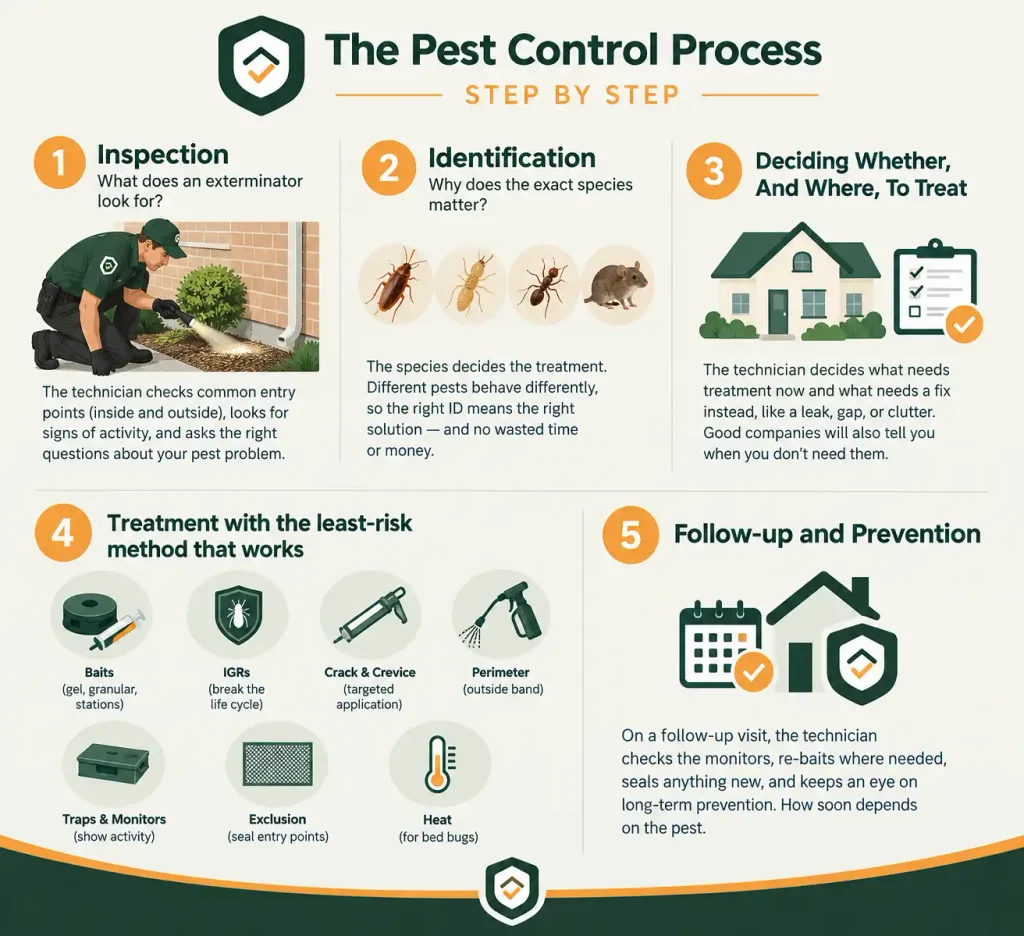
Professional pest control has five steps. The technician inspects the property, identifies the exact species, decides whether and where treatment is needed, treats with the method that fits that pest, and follows up to confirm it worked. This approach is called integrated pest management (IPM), and it’s what the EPA and Texas A&M AgriLife Extension recommend.
The spray most people picture is only one of those tools. For German roaches, fire ants, termites, rats and bed bugs, a spray alone is the wrong choice.
This guide covers how a licensed technician handles each step on a Rosenberg home and what changes from pest to pest. It also covers the Texas rules you can check before you hire anyone, including us.
How does professional pest control work?
It works by making a decision before a product comes out of the truck. The EPA describes integrated pest management as a series of evaluations, decisions and controls, not one single method.
3 ideas drive it:
- One bug doesn’t always mean treatment. IPM sets an “action threshold”: the point where pest numbers or conditions call for action. A single ground beetle after a storm is different from one German roach in the kitchen, which usually means more are hiding.
- Prevention comes first. Fixing gaps, leaks and food sources keeps pests from coming back once they’re gone.
- Least risk first, then escalate. Lower-risk controls such as traps, baits and sealing come first. Targeted pesticide applications are added when monitoring shows the lower-risk options aren’t enough.
That’s why a good technician spends more time looking than spraying.
The pest control process, step by step
Step 1: Inspection. What does an exterminator look for?
Most pests get in from outside, so a real inspection starts there. On a typical Rosenberg home (slab foundation, brick walls), the technician checks:
- Weep holes along the bottom row of brick
- Where the driveway, patio and garage slab meet the foundation, plus the slab’s expansion joints
- Plumbing and AC line penetrations, and the AC pad
- Garage door seals and door sweeps
- The roofline, soffits and any branches touching the roof
- Mulch piled against the slab, and wood touching soil (fences, landscape timbers)
- Inside: under sinks, behind the fridge and stove, bath traps, the garage and the attic
They should also ask you questions: what you’ve seen, where, at what time of day, and what you’ve already sprayed. Skipping those questions turns the visit into a guess.
Step 2: Identification. Why does the exact species matter?
The species decides the treatment. German cockroaches live their whole lives indoors in Texas, while American and smokybrown roaches usually come in from outside. They’re the same “roach problem” with opposite fixes.
The same is true for other pests. Native subterranean and Formosan termites swarm at different times of year and day. Tawny crazy ants don’t respond well to most ant baits, according to Texas A&M AgriLife. A wrong ID means the wrong product, and you end up paying twice.
Step 3: Deciding whether, and where, to treat
This is the action threshold in practice. The technician decides what needs treatment now and what needs a fix instead, such as a leak, a gap, or cardboard piled in the garage. Good companies will also tell you when you don’t need them.
Step 4: Treatment with the least-risk method that works
The toolbox is much bigger than a sprayer:
- Baits: gel bait, granular bait and bait stations. Pests carry them back to the colony.
- Insect growth regulators (IGRs): break the life cycle so young insects can’t develop into breeding adults.
- Crack-and-crevice treatment: small, targeted applications into the gaps where insects hide, instead of spraying open surfaces.
- Perimeter treatment: a band along the foundation, eaves and entry points outside.
- Traps and monitors: snap traps for rodents and sticky monitors for insects. Monitors show where activity is and whether it’s dropping.
- Exclusion: sealing the way in with hardware cloth, metal mesh, door sweeps and sealant.
- Heat: used mainly for bed bugs.
Step 5: Follow-up and prevention
The EPA’s IPM guidance treats monitoring and record-keeping as part of the job. On a follow-up visit, the technician checks the monitors, re-baits where needed and seals anything new. How soon that happens depends on the pest.
Do exterminators just spray? How pest control is done for each pest
No. The method depends on where the pest lives and how it breeds. The table shows how professionals get rid of the most common Rosenberg pests, and why a spray alone falls short for each one.
| Pest | How it’s done | Why a spray alone falls short |
|---|---|---|
| German cockroaches | Small, pea-sized placements of gel bait where roaches hide, plus bait stations and an IGR. Baits are rotated every 3–6 months | Texas A&M calls baseboard sprays ineffective for German roaches. Repellent sprays also keep roaches away from the bait |
| American and smokybrown roaches | Perimeter treatment, mesh in weep holes, door sweeps, spot baits inside | They live outdoors and walk in. Spraying inside misses where they come from |
| Fire ants | Texas A&M’s Two-Step Method: broadcast bait over the whole yard, then treat problem mounds near the house | Treating mounds only is temporary. New colonies move in from the surrounding area |
| Subterranean termites | Non-repellent liquid termiticide placed by trenching, and drilling through slabs where needed, or a bait system with monitoring | The colony lives in the soil, out of reach of a surface spray |
| Rats and mice | Plenty of snap traps inside, bait stations outside only where safe, and sealing gaps with hardware cloth and metal mesh | Poison alone can leave dead rodents in walls (odor, flies) and doesn’t stop new ones getting in |
| Bed bugs | Heat, conventional treatment, or both, with follow-ups. Adults die almost immediately at 118°F and eggs at 122°F | Insecticide resistance is a known problem. Bug bombs scatter bed bugs instead of reaching them |
| Mosquitoes | Dump standing water, treat water that can’t be drained, and treat shady resting spots, repeated about every 14–21 days | New adults keep hatching from breeding water |
| Fleas | The pet treated (talk to your vet), plus the home (vacuum, adulticide and IGR) and the shady spots in the yard where pets rest | Pupae in cocoons survive treatment. The full cycle takes 4–6 weeks to control |
What’s different about pest control in Rosenberg?
The steps are the same everywhere. What a technician focuses on here comes down to climate, water and how local homes are built.
- Mild winters. Gulf Coast humidity and short cold snaps slow pests down but rarely stop them. That’s why prevention and follow-up matter more here than in colder states.
- Heavy rain and Brazos high water. After flooding, fire ants rebuild mounds on high ground, often against the slab or AC pad. Rodents move toward houses, and every pocket of standing water can breed mosquitoes. An inspection after a big storm looks at those spots first.
- Lake neighborhoods. Communities built around retention lakes, such as Bonbrook Plantation and Summer Lakes, deal with more mosquitoes. The City of Rosenberg sprays within city limits during peak season, but not alleys or private yards.
- New sections. Freshly graded land and new mulch beds in areas like Brookewater and Sendero bring fire ants and other ants close to new slabs.
- Brick and weep holes. Weep holes let moisture drain from behind the brick, so they should never be sealed with mortar or caulk. If roaches or mice use them, a technician fits breathable stainless steel or copper mesh inserts instead.
We treat homes across 77471 and 77469, and also serve Richmond, Pecan Grove, Sugar Land and Fulshear.
Can I do pest control myself?
Yes, for prevention and light problems, and your part matters even when a pro is treating. Some common DIY moves, though, undo professional work.
DIY moves that make it worse
- Spraying store-bought bug spray over roach bait. Repellent sprays make baits less effective.
- Setting off bug bombs for bed bugs. They scatter bed bugs deeper into walls and furniture.
- Moving to another bedroom to escape bed bugs. You carry them with you and spread the problem.
- Pouring gasoline on fire ant mounds. Texas A&M AgriLife says not to use gasoline or any petroleum product.
- Treating fire ant mounds one at a time all year. Without a broadcast bait step, new colonies keep moving in.
- Putting poison inside the house for mice. A rodent can die inside a wall and leave an odor that lasts.
- Sealing weep holes with caulk or mortar. It can trap water against the framing. Use mesh inserts instead.
DIY that works
- Empty water from flower pots, buckets, birdbaths and toys once or twice a week. Asian tiger mosquitoes don’t fly far, so the breeding site is usually in your yard or your neighbor’s.
- Keep mulch pulled back from the slab, and don’t let wood touch the soil.
- Trim branches that touch the roof. They give roof rats an easy route in.
- Fix leaks under sinks, and store food and pet food in sealed containers.
- Add door sweeps, and seal gaps around pipes and AC lines.
If a problem keeps coming back after a few weeks of this, you’re likely dealing with a colony, a nest or an entry point you can’t see. That’s when an inspection pays for itself.
FAQ
How long does pest control take to work?
It depends on the pest and the method. Texas A&M says flea control takes 4–6 weeks, because eggs and pupae have to cycle through. Broadcast fire ant bait reduces colonies by 80–90%, with control lasting 3–12 months. German roaches and rodents need follow-up visits until the monitors show no new activity.
Is one pest control treatment enough?
Sometimes. A single paper wasp nest may need only one visit. German roaches, bed bugs, fleas and rodents almost never clear up in one visit, because eggs hatch and new animals arrive after the first treatment. Mosquito yard treatments repeat about every 14–21 days through the season. A good company plans the follow-ups from the start.
What do exterminators spray around a house?
Outside, usually a perimeter treatment along the foundation, eaves, doors and other entry points. Inside, it’s mostly crack-and-crevice treatment and baits rather than open spraying. The product depends on the pest and has to be used according to its label. Ask your technician what they used. A Texas termite treatment sticker lists the product by law.
How often should you get pest control in Rosenberg?
Many homeowners here use a quarterly plan for everyday pests such as ants, outdoor roaches and spiders, because mild winters keep pests active most of the year. Termites, mosquitoes, bed bugs and German roach infestations run on their own schedules. See how our quarterly pest control service works.
Why do bugs come back after spraying?
Usually because the source wasn’t treated. The colony may live outdoors, the mounds may have been treated without broadcast bait, a repellent spray may have kept insects away from the bait, or the entry points were never sealed. Seeing more insects for a short time right after a treatment can be normal while they’re flushed out.
Does a general pest control plan cover termites?
No. Termite work is a separate TDA license category and a separate treatment, with its own proposal rules. A general plan covers everyday insects. Termites need an inspection and their own termite treatment plan. Check what’s included and what’s not treated before you sign anything.
Want it inspected before anyone sprays?
Pest Control Rosenberg Pros starts every job with an inspection and a species ID, then gives you the price before any work begins.
Call (281) 549-0821 · Request a free inspection
— Free inspection
Pest problem in Rosenberg?
Tell us what you’re seeing. We’ll find it and give you a written price before any work starts.
Answering calls 24/7 · Same-day when you call before noon
— Contact us
Have a Pest Problem in Rosenberg?
Tell us what you’re seeing. We’ll find it, explain it and give you a written price before any work starts. No pressure and no obligation.
Request a free inspection
No pressure and no obligation.
We’ll call you back within 1 hour.