
Scratching in the Attic at Night? Why Roof Rats Move Into Rosenberg Homes in Fall

In a Rosenberg home, light scratching, scurrying or gnawing in the attic after dark is most often a roof rat, and fall is when it tends to start. As nights cool and outdoor food and cover shrink, roof rats look for a warm, dry, protected place to nest, and an attic fits. But it isn’t always rats. The time you hear it, the kind of sound and what you find in the insulation will tell you whether it’s a rat, a mouse, a squirrel, a raccoon, an opossum or a bat, and the right fix is different for each.
This guide helps you work out what’s up there, why fall brings it on in Rosenberg, what to do first and what to avoid.
What is making noise in my attic at night?
Start with when you hear it and what it sounds like.
| Animal | What it sounds like | When you hear it | Other clues |
|---|---|---|---|
| Roof rat | Light to medium scurrying, scratching, gnawing, squeaks, sometimes squealing fights | Mostly after sunset into the late evening, and again before dawn | Droppings about ½ to ¾ inch long with pointed ends, greasy rub marks along beams and pipes, chewed wires, shredded insulation nests |
| House mouse | Faint, light scratching and tiny pattering | Night, but also quiet times of day | Rice-sized droppings, small gnaw marks |
| Tree squirrel | Fast scampering, bouncing or rolling sounds | Mostly daytime, especially morning and late afternoon | Chewed soffits or fascia, a 1/2-inch gap is enough for entry |
| Raccoon | Heavy thumping, dragging, sometimes chittering or growling | After dark | Torn insulation, large piles of droppings in one spot |
| Opossum | Slow, heavy dragging or shuffling | After dark only | Scattered droppings, strong odor |
| Bat | High-pitched chirps and clicks as a colony | Around dusk and dawn | Dark staining near entry points, no gnawing |
| Birds | Fluttering and light scratching | Early morning, near the eaves | Nesting material near vents |
Not every noise is an animal. Banging or popping at night is often thermal expansion: the roof decking, ducts and framing cool after sunset and shift slightly. If it’s one or two pops as evening cools, with no scratching and no droppings, that’s a likely cause. Rhythmic thumping, dragging or movement that travels across the ceiling points to an animal.
Why roof rats move into Rosenberg homes in fall
Roof rats don’t hibernate and they don’t “migrate” in a big group. What changes in fall is the trade-off for each rat. When nights cool and natural food and cover decline, rats move closer to reliable food and warm, protected nesting spots. Pest guidance from universities and industry sources describes the pattern as starting as early as August and running into October, with another rise in activity in early winter.
Several things stack up in a Rosenberg neighborhood:
- They live up high already. Roof rats are agile climbers that usually nest above ground in shrubs, trees and dense vegetation, and they spend most of their lives off the ground. Mature trees, thick ivy and fences give them a path to your roofline.
- They use the same routes every night. Roof rats travel along tree limbs, fences and utility lines, which is why they can reach a roof without ever touching the ground near your door.
- Autumn food shows up. Fallen pecans, acorns and citrus, plus bird seed, pet food and unsecured trash, give rats a reason to settle close by.
- Mild winters keep them active. Rosenberg’s climate means rats don’t have to go dormant, and they breed more or less all year, so a small problem can grow fast.
- Attics are ideal nest sites. They’re warm, dry, quiet and full of insulation and stored boxes.
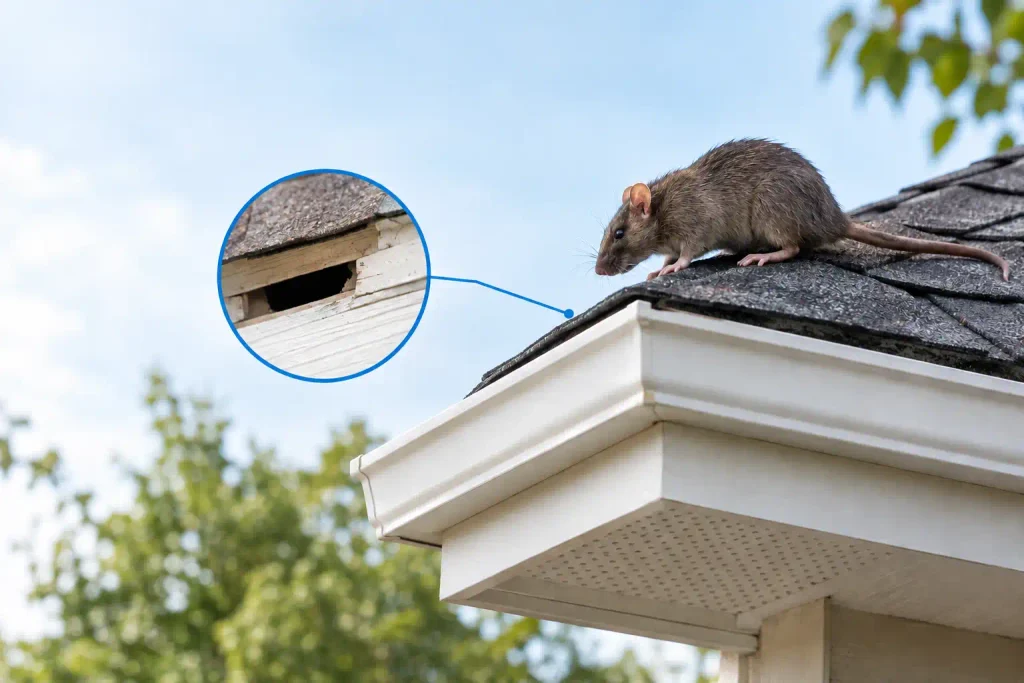
How roof rats get in
A roof rat can squeeze through a gap about 1/2 inch wide, or a hole about the size of a quarter. Texas A&M AgriLife lists the most common entry points on a typical home:
- Gaps around the garage door
- Roof vents and flashing
- Gaps around siding at ground level
- Crawl-space openings on older homes
To that list, add the places where wires, pipes and dryer vents pass through walls or the roofline, soffit gaps, and any tree limb that touches or hangs near the roof.
Signs of rats in the attic (besides noise)
- Droppings along beams, walls, stored boxes and travel paths. Fresh ones are soft and dark. Older ones dry and harden.
- Gnaw marks on wood, plastic, pipes and especially electrical wiring.
- Grease or dirt smears along regular paths.
- Nests of shredded insulation, paper or fabric.
- Odor from urine, droppings or a dead rodent.
- Pets staring at the ceiling or scratching at walls.
- Sightings in daylight. Rats are mainly nocturnal, so seeing them in the day often suggests a larger population.
Noises but no droppings?
That doesn’t mean there’s nothing there. Common reasons include:
- Early stage. A single rat or a brand-new nest may not have left much yet.
- You’re not looking where they travel. Droppings pile up along runways, near nests and under entry points, and insulation can hide them.
- It isn’t a rodent. Squirrels, birds and bats leave different droppings, and thermal expansion leaves none.
If noises continue for more than a night or two, get the attic checked by someone qualified rather than waiting for droppings to appear.
Why you shouldn’t ignore it
- Fire risk. Rats chew electrical wiring, and AgriLife notes this can start fires.
- Contamination. They soil insulation, stored items and ducts.
- Fleas and flea-borne typhus. Rats and their fleas are a natural reservoir for flea-borne (murine) typhus. Texas reports more cases than any other state, and the disease has been emerging in the Greater Houston area. The Texas Department of State Health Services says cases usually peak from May to July and again in December and January, and that it is treatable with antibiotics. See a doctor if you have fever and headache after exposure to fleas or rodents.
What to do first
1. Confirm what you’re dealing with
Note the time, the type of sound and where in the house it comes from. At dusk, look outside for rats moving along fences, wires or tree limbs. If you go into the attic, wear gloves and a well-fitted mask, use a flashlight, and don’t sweep or vacuum droppings, which can send particles into the air. Dampen and wipe instead.
2. Find the entry points, and seal them in the right order
AgriLife stresses that inspecting and sealing entry points is the first step, and many people skip it and fail. The one catch: sealing every hole while animals are still inside can trap them. The usual approach is to find every opening, then close them as you remove the animals (or have a professional sequence it).
Good sealing materials include cement, brass or stainless steel wool, metal mesh and products like Xcluder, with low-expansion foam used sparingly. Foam alone is not a barrier, because rats can chew through it.
3. Trap, and use more traps than you think you need
Snap traps are fast and humane compared with glue boards. AgriLife offers a few practical rules:
- Triple the number of traps you think you need, because if you see one rat there are probably more.
- Place traps along rafters, next to stored boxes and wherever you find droppings. Roof rats tend to travel off the ground, so place traps up high.
- Good baits include peanut butter, seeds, fruit, chocolate and even cotton balls (they use them as nesting material).
- Pre-bait with unset traps for several days to a week so wary rats get used to them.
- Check traps daily and wear gloves when you remove them.
4. Treat for fleas before you start rodent control
The Texas DSHS advises treating for fleas before rodent control, because when rodents die their fleas look for new hosts, which may be you or your pets. Keep your pets’ flea prevention up to date.
5. Be careful with poison
AgriLife considers rodenticides a second choice for attics because rats can die in places you can’t reach, causing odors and fly problems, and there is a small chance of secondary poisoning for pets or predatory birds. If bait is used, it should be secured in a tamper-resistant bait station, never scattered loose. Don’t count on the old claim that rats leave to find water before they die.
6. Remove what’s drawing them in
- Trim tree limbs so none are within at least 3 feet of the roof.
- Cut back ivy and dense vegetation against the house.
- Pick up fallen pecans, fruit and bird seed.
- Store pet food indoors overnight and keep trash lids tight.
- Reduce clutter in the garage and attic.
What doesn’t work
- Ultrasonic devices and loud noise. Lab studies going back decades report that rats habituate to repeated sounds, and none of the Texas A&M or UC guidance we reviewed recommends sound devices for rats. A radio in the attic may annoy them for a night. It won’t evict them.
- Peppermint oil, mothballs and other smells. Evidence is weak, and any effect fades quickly. Mothballs also aren’t labeled for this use and are hazardous indoors.
- Trapping or poisoning without sealing. New rats will keep arriving until the entry points are closed.
- Sealing the holes while rats are inside. You risk trapping animals that then chew new holes or die in the walls.
When to call a professional
Call a licensed technician if:
- Noises continue after a week of trapping
- You can’t safely reach the roofline, vents and flashing
- You suspect chewed wiring
- You’re not sure the animal is a rat (squirrels, raccoons and bats need different methods)
- You find a large amount of droppings, nesting or contaminated insulation
Our rodent control service starts with a full inspection of the attic, roofline and exterior, finds every entry point, and gives you a price before work begins. Call us, or see what pests are active each month in our Rosenberg pest calendar.
Frequently asked questions
Why do I hear scratching in my ceiling at night?
Most commonly it’s a nocturnal animal moving through the attic. In Rosenberg that’s often a roof rat, especially in fall. Mice, raccoons, opossums and bats are other possibilities. The timing and type of sound help tell them apart.
What is in my attic that scratches at night?
Light scratching and scurrying after dark usually means a rat or mouse. Heavy thumping or dragging suggests a raccoon or opossum. Chirping at dusk suggests bats. Squirrels are usually active in the daytime.
What is making noise in my attic at night but not leaving droppings?
It could be an early rodent infestation, droppings hidden in insulation, a squirrel, bird or bat, or thermal expansion of the roof and ducts as it cools. Persistent scratching deserves an inspection even without droppings.
What are the signs that rats are in my attic?
Nighttime scurrying, pointed droppings about ½ to ¾ inch long, gnawed wires or wood, greasy rub marks, shredded insulation nests, odors and pets fixated on the ceiling. Daytime sightings often mean a larger population.
What does a rat in the attic sound like?
Fast scurrying and scratching along rafters, gnawing, occasional squeaks or squeals, and sometimes dragging as rats carry nesting material. It’s usually lighter than a raccoon and heavier than a mouse.
Why am I hearing scratching in the attic in the early morning or during the day?
Rats are most active after dark but often return to the nest before dawn. Daytime activity can mean squirrels, birds, or a rat colony large enough to be active in daylight.
What does a squirrel in the attic sound like at night?
Squirrels are mostly active in the daytime, so nighttime noise is more likely a rat, raccoon, opossum or flying squirrel. Squirrels typically sound like fast scampering and bouncing in the morning and late afternoon.
What do rats hate most at night?
No smell or sound has been shown to reliably drive them away. What rats avoid is exposure, disturbance and unfamiliar objects, which is why pre-baiting traps helps. What actually ends an infestation is closed entry points plus removing the rats that are inside.
What is a rat’s biggest enemy?
In the wild, predators such as owls, hawks, snakes, coyotes and cats. They won’t solve an attic problem, though, and rodent poison can harm the predatory birds that eat poisoned rats.
What month are rats most active?
Rats are active all year in Texas. Activity becomes most noticeable in fall and early winter as they seek shelter, with another rise in spring when they nest and raise young.
How can I scare rats away with noise at night?
You can’t, at least not for long. Research indicates rats get used to repeated sounds, including ultrasonic ones. Seal entry points and trap instead.
— Free inspection
Pest problem in Rosenberg?
Tell us what you’re seeing. We’ll find it and give you a written price before any work starts.
Answering calls 24/7 · Same-day when you call before noon
— Contact us
Have a Pest Problem in Rosenberg?
Tell us what you’re seeing. We’ll find it, explain it and give you a written price before any work starts. No pressure and no obligation.
Request a free inspection
No pressure and no obligation.
We’ll call you back within 1 hour.