
Tawny Crazy Ants in Fort Bend County: How to Spot Them, Why Baits Fail, and What Actually Works

If you’ve sprayed a trail of small reddish-brown ants and come back the next morning to even more of them, plus a pile of dead ones in the corner of the garage, you may not be dealing with an ordinary ant. Tawny crazy ants are an invasive ant from South America, and Fort Bend County is one of the Texas counties where Texas A&M has confirmed them.
They don’t sting like fire ants, and they don’t build mounds. What makes them hard to control is their numbers. This guide covers how to tell them apart from other ants, what the research says about why ant baits fail against them, and the method Texas A&M recommends instead.
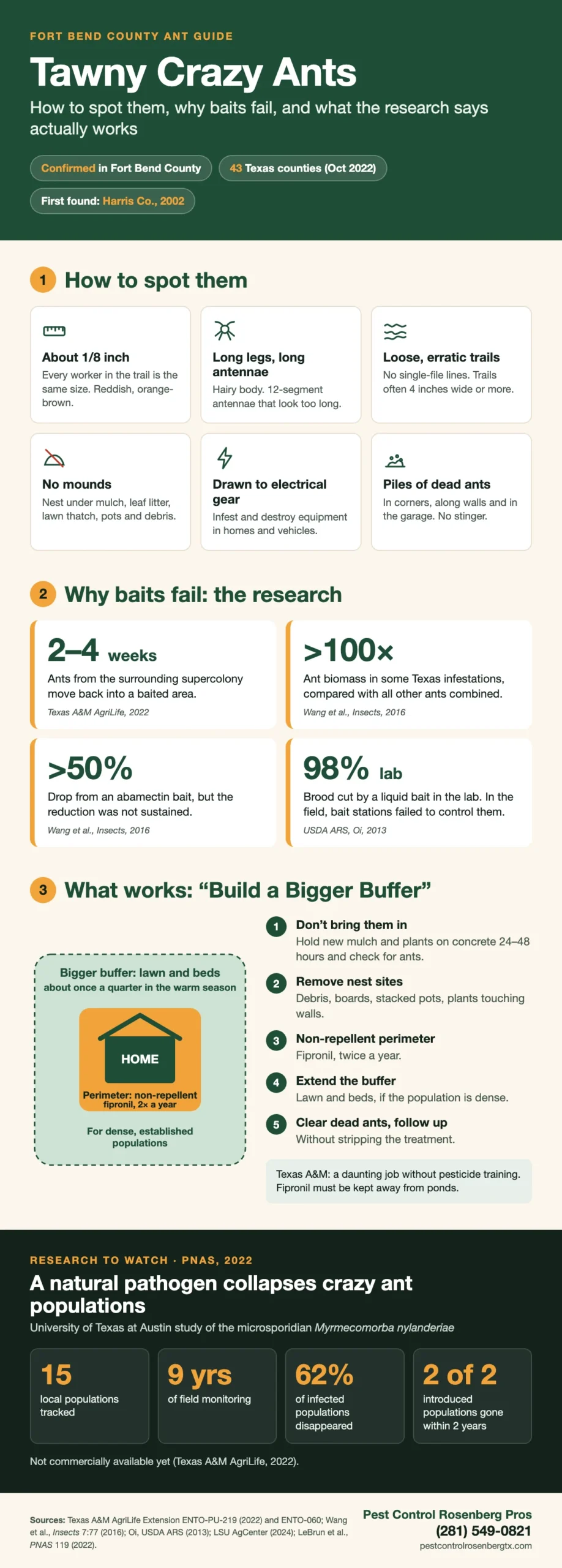
Tawny crazy ants are small (about 1/8 inch), reddish-brown ants that run in loose, erratic trails, build no mounds and show up in huge numbers. They are confirmed in Fort Bend County. Baits usually fail because the ants live in huge multi-queen supercolonies: Texas A&M found that baits are only marginally effective long term, and ants from the surrounding population move back into a baited area within 2 to 4 weeks. What works is removing the moist clutter they nest under, a non-repellent perimeter treatment twice a year, and, for heavy infestations, a wider treated “buffer” across the lawn and beds, which Texas A&M says can cut treatments to about once a quarter in the warm season.
Tawny crazy ants at a glance
| Question | Answer | Source |
|---|---|---|
| Scientific name | Nylanderia fulva, called the “Rasberry crazy ant” in Texas | Texas A&M AgriLife |
| First found in Texas | Harris County, 2002 | Texas A&M AgriLife |
| Texas counties confirmed | 43 as of October 2022, including Fort Bend, Harris, Brazoria and Wharton | Texas A&M AgriLife |
| Other states | Louisiana, Mississippi, Alabama, Georgia and Florida | Texas A&M AgriLife |
| Size | About 1/8 inch (2 mm); every worker is the same size | Texas A&M AgriLife |
| Mounds | None; they nest under mulch, debris, pots and lawn thatch | Texas A&M AgriLife |
| Sting | No stinger; the bite is a sharp pain that fades quickly | LSU AgCenter |
| Colony | Supercolonies with many queens | Texas A&M AgriLife |
| Do baits work? | Only marginally on established populations; ants reinvade in 2 to 4 weeks | Texas A&M AgriLife |
Are tawny crazy ants in Fort Bend County?
Yes. Texas A&M’s Rollins Urban and Structural Entomology Facility lists Fort Bend among 43 Texas counties with at least one confirmed tawny crazy ant population as of October 2022, according to the AgriLife guide Tawny Crazy Ant Management: Build a Bigger Buffer. Harris, Brazoria, Wharton, Galveston and Colorado counties are on the same list.
The ants were first found in Harris County in 2002. Texans first called them “Rasberry crazy ants” after Tom Rasberry, the pest management professional who brought them to Texas A&M’s attention. Once scientists confirmed the species, the Entomological Society of America made “tawny crazy ant” the official common name. Both names mean the same ant.
They spread mostly with people’s help. Texas A&M says infested plants, construction materials, mulch, yard debris, hay bales and RVs carry them to new places, and there is no federal quarantine to stop that. On their own they move slowly: a 2016 research review reported that Texas populations spread about 20 to 30 meters (roughly 65 to 100 feet) a month between 2002 and 2006. That’s worth knowing if you’re adding mulch, new beds or nursery plants to your yard.
How to spot tawny crazy ants
Texas A&M’s brochure Tawny Crazy Ants: A Texas-Size Problem warns that they’re hard to identify without magnification, because they look like several native ants. These are the clues to look for:
- Size and color. About 1/8 inch long and reddish or orange-brown (“tawny”). Every worker in the trail is the same size.
- Long legs and very long antennae. The antennae have 12 segments and look almost too long for the body.
- Hairy bodies. The most reliable feature is two pairs of stiff, standing hairs on the middle of the body, but you need a magnifier to see them.
- Loose, erratic trails. They run in all directions instead of single-file lines. LSU AgCenter notes their trails are often 4 inches wide or more.
- No mounds. They nest under anything that holds moisture: mulch, leaf litter, the thatch layer of the lawn, potted plants, paving stones, boards and tree bark.
- They climb. Texas A&M notes they move readily onto trees and shrubs.
- Piles of dead ants. Alabama Extension describes large numbers of dead ants piled in the corners of structures as a telltale sign.
- Ants in electrical equipment. Texas A&M says they infest and destroy electrical equipment in homes and vehicles.
Tawny crazy ant or fire ant?
| Clue | Tawny crazy ant | Red imported fire ant |
|---|---|---|
| Worker size | All about 1/8 inch, all the same size | Mixed sizes, about 1/16 to 3/16 inch in the same colony |
| Look | Reddish-brown, hairy, very long legs and antennae | Reddish-brown to dark |
| Trails | Loose, erratic and wide | Orderly lines |
| Nest | No mound; under mulch, debris, pots and lawn thatch | Dome-shaped mounds of loose soil |
| When disturbed | Scatter | Swarm up vertical surfaces and sting |
| Sting | No stinger; bite fades quickly | Painful sting; white pustule in a day or two |
If you’re still not sure, Texas A&M recommends having a trained entomologist confirm the identification. Samples can go to the Rollins Urban and Structural Entomology Facility at Texas A&M (979-845-5855). If they turn out to be fire ants, our guide to fire ants in the house and the Texas Two-Step method are the better place to start.
Why do tawny crazy ants take over a yard so fast?
Texas A&M says a new population can reach “extraordinary densities within a year or two.” Four things drive that:
- Supercolonies. Unrelated workers and queens live together without fighting, so the whole yard (and the neighbor’s yard) acts like one giant colony with many queens.
- Sheer numbers. The 2016 review in Insects reported that some Texas infestations had more than 100 times the ant biomass of all other ant species combined.
- They win the food. Where tawny crazy ants and fire ants were found in similar numbers, the crazy ants took more than 90% of the food. They also collect the sweet honeydew made by sap-feeding insects on trees and shrubs, which is why you see them climbing.
- Moist, sheltered nest sites. They thrive in the damp layer under mulch, leaf litter and lawn thatch. Rosenberg’s humid Gulf Coast climate gives them plenty of that, which is part of why Rosenberg has bugs year-round.
The study that explains why they beat fire ants
In a 2014 study published in Science, researchers at the University of Texas at Austin found that tawny crazy ants neutralize fire ant venom. When a fire ant daubs them with venom, the crazy ants coat themselves with formic acid from a gland at the tip of the abdomen. With the gland working, 98% of crazy ants survived. With the gland sealed off, only about half did (ScienceDaily summary). Texas A&M notes that many researchers have since recorded fire ant numbers dropping where tawny crazy ants move in. That’s not a good trade: crazy ants come in far greater numbers and are harder to control.
Why do ant baits fail against tawny crazy ants?
Baits work on fire ants because foragers carry the poison back to the colony and the colony dies. With tawny crazy ants, the research shows several ways that breaks down:
| What the research found | Source |
|---|---|
| Granular and gel baits labeled for tawny crazy ants are “only marginally effective” at long-term control of established populations, and they leave little to no protection behind. | Texas A&M AgriLife, 2022 |
| Baits kill many workers and queens, but ants from the larger population move back into the baited area within 2 to 4 weeks. | Texas A&M AgriLife, 2022 |
| Many baits that work on fire ants are not attractive to tawny crazy ants. | Wang et al., Insects, 2016 |
| An abamectin bait cut populations by more than 50%, but the reduction wasn’t sustained. | Wang et al., 2016 |
| In the lab, a diluted liquid imidacloprid bait cut the ants’ brood by 98% in three weeks. In the field, large bait stations failed to control them, even though marked ants that fed on the bait were found more than 30 meters (about 100 feet) away. | USDA ARS, Oi, 2013 |
| Few bait products have proven attractive, and the ants can’t be counted on to keep taking the same bait. | LSU AgCenter, 2024 |
| Baiting inside can draw foragers into the home, and granular products often don’t work during drought or without irrigation. | Alabama Extension, ANR-2546 |
In plain terms: a bait can kill a lot of ants, but there are so many more in the yard, and the neighbors’ yards, that the gap fills back in within weeks. LSU AgCenter notes that baits are most useful in early spring, or when a population has just arrived, while numbers are still low.
Why store-bought sprays don’t fix it either
Spraying the trail kills the ants you can see, but Texas A&M notes that tawny crazy ants need significantly more contact insecticide than other pest ants. Dead ants also pile up on treated surfaces. LSU AgCenter says those piles must be removed so the area underneath can be treated, otherwise the living ants keep coming over them.
What actually works: Texas A&M’s “Build a Bigger Buffer” method
Texas A&M’s management guide describes the approach that has become the standard for pest management professionals dealing with tawny crazy ants. Here’s how it works, step by step.
- Don’t bring them in. Texas A&M calls this the best management practice. Buy plants, mulch and soil from dealers who inspect for ants, check fallen trees before mulching or grinding them, and hold new landscape material on concrete or asphalt for 24 to 48 hours and look for ants before you spread it.
- Remove nest sites. Clear out debris, boards, stacked pots and clutter near the house, and trim plants back so they don’t touch the walls or gutters. Every object that holds moisture underneath is a potential nest.
- Treat the perimeter with a non-repellent. Texas A&M says a non-repellent insecticide containing fipronil, applied to the outside perimeter twice a year, may protect the home. If the population is new and numbers are low, that may be enough.
- Build a bigger buffer. If the home sits inside a dense, established population, the treated area needs to extend into the surrounding lawn and landscape beds with another contact insecticide labeled for tawny crazy ants. Texas A&M says research shows this can reduce treatments to once a quarter during the warm season.
- Clear the dead ants. Use a leaf blower outside or a vacuum inside, in a way that doesn’t strip the treatment off the surface, so the living ants can’t avoid it.
- Plan for follow-up. Alabama Extension notes that frequent return visits may be needed and that long-term relief from chemical control alone is unlikely. LSU AgCenter found that the ants crossed treated buffer zones within 2 to 3 months.
Why the buffer is a job for a licensed applicator
Texas A&M says the buffer method can be “a daunting task” for homeowners without experience or pesticide application training, and it advises talking to several pest management professionals about the cost and expected results. There’s also water to think about: LSU AgCenter notes that fipronil is toxic to fish, aquatic invertebrates and birds, so ponds and the water that drains into them must be protected. That matters in Rosenberg neighborhoods built around retention ponds.
Tawny crazy ants in your AC unit, breaker box or car
Tawny crazy ants don’t just crawl around electrical equipment; they damage it. Texas A&M says they infest and destroy electrical equipment in homes and vehicles, and the 2016 Insects review notes that their foraging and nesting cause short circuits. LSU AgCenter reports short circuits and equipment failure.
If you find them in an outlet, the breaker box, the AC disconnect or the outdoor AC unit:
- Don’t spray liquid into electrical equipment.
- Turn off the power to that equipment if you can do it safely.
- Call an electrician or a licensed pest professional. Texas A&M gives the same advice for fire ants in electrical equipment: only electricians or licensed pest control operators should treat it, with the power off.
What the latest research says: a natural disease that wipes them out
The most promising long-term answer isn’t a chemical. In 2015, scientists described a microsporidian pathogen, Myrmecomorba nylanderiae, infecting tawny crazy ants in Texas and Florida. In 2022, a University of Texas at Austin team published a study in PNAS that tracked 15 local populations over 9 years:
- Every infected population that was sampled over time declined, and 62% disappeared entirely.
- The researchers introduced the pathogen into two populations, and the ants were eliminated within 2 years.
- The pathogen shortens the lives of worker ants, and it hasn’t been found in other ant species (Texas Invasives, April 2022).
Texas A&M cautions that this work is at an early stage and that the pathogen is not commercially available. For now, the buffer method is the tool homeowners have.
FAQ’s
Are tawny crazy ants dangerous?
Not medically. They have no stinger, and LSU AgCenter describes their bite as a sharp pain that fades quickly. The harm is their numbers, the nuisance in and around the home, and the damage they do to electrical equipment.
Why do tawny crazy ants keep coming back after I spray?
Because the ants you kill are a small part of the population. They live in supercolonies with many queens, so ants from the surrounding area move back in. Texas A&M found that ants reinvade a baited area within 2 to 4 weeks, and piles of dead ants can cover treated surfaces.
What is the best bait for tawny crazy ants?
No bait reliably controls an established population. Texas A&M found baits labeled for them are only marginally effective long term. LSU AgCenter says baiting is most useful in early spring or when the ants have just arrived, and Alabama Extension advises against baiting inside the home.
Are tawny crazy ants the same as Rasberry crazy ants?
Yes. “Rasberry crazy ant” was the name used in Texas after the ants were first found in 2002. “Tawny crazy ant” is the official common name for the same species, Nylanderia fulva.
Do tawny crazy ants kill fire ants?
They outcompete them. A 2014 study in Science found that crazy ants neutralize fire ant venom with their own formic acid, and Texas A&M notes that fire ant numbers drop where tawny crazy ants move in.
Can you get rid of tawny crazy ants for good?
Not with chemicals alone, according to the extension research. Texas A&M’s buffer method can keep them out of the home with treatments about once a quarter in the warm season, but follow-up is part of the plan. A natural pathogen has wiped out some populations in studies, but it isn’t available to homeowners yet.
How we handle tawny crazy ants
Our ant control service starts with an inspection to confirm the species and find where the ants are nesting. For tawny crazy ants, we follow the Texas A&M buffer approach described above. You get a written price after the inspection.
Sources
- Texas A&M AgriLife Extension. Puckett, R.T., Brown, W., and Keck, M. Tawny Crazy Ant Management: Build a Bigger Buffer. ENTO-PU-219, December 2022.
- Texas A&M AgriLife Extension. Puckett, R.T. Tawny Crazy Ants: A Texas-Size Problem. ENTO-060, September 2016.
- Urban and Structural Entomology Program, Texas A&M University. Tawny (Rasberry) Crazy Ant, Nylanderia fulva.
- Texas A&M AgriLife Extension. Managing Imported Fire Ants in Urban Areas. B-6043.
- Wang, Z., Moshman, L., Kraus, E.C., Wilson, B.E., Acharya, N., and Diaz, R. A Review of the Tawny Crazy Ant, Nylanderia fulva, an Emergent Ant Invader in the Southern United States: Is Biological Control a Feasible Management Option? Insects 7(4): 77, 2016.
- Oi, D.H. Musings on the Management of Nylanderia fulva Crazy Ants. USDA Agricultural Research Service, Imported Fire Ant Conference Proceedings, 2013.
- LeBrun, E.G., Jones, N.T., and Gilbert, L.E. Chemical Warfare Among Invaders: A Detoxification Interaction Facilitates an Ant Invasion. Science 343: 1014–1017, 2014 (ScienceDaily summary).
- LeBrun, E.G., et al. Pathogen-Mediated Natural and Manipulated Population Collapse in an Invasive Social Insect. PNAS 119(14): e2114558119, 2022.
- Plowes, R.M., et al. Myrmecomorba nylanderiae gen. et sp. nov., a Microsporidian Parasite of the Tawny Crazy Ant Nylanderia fulva. Journal of Invertebrate Pathology 129: 45–56, 2015.
- LSU AgCenter. Ferguson, M. Tawny Crazy Ants: No Stingers but Pests Nonetheless. September 2024.
- LSU AgCenter. Ring, D.R. Tawny Crazy Ants. 2018.
- Alabama Cooperative Extension System. Graham, F., Suiter, D.R., Davis, R.W., and Puckett, R.T. Managing Tawny Crazy Ants: Guidelines for the Pest Management Professional. ANR-2546, 2019 (reviewed 2022).
- Texas Invasive Species Institute. iWire Newsletter, April 2022.
Seeing crazy ants around your home?
We treat ants in homes across Rosenberg and nearby Richmond and Pecan Grove. Call (281) 549-0821 24/7 for a free inspection, or learn more about our pest control in Rosenberg.
— Free inspection
Pest problem in Rosenberg?
Tell us what you’re seeing. We’ll find it and give you a written price before any work starts.
Answering calls 24/7 · Same-day when you call before noon
— Contact us
Have a Pest Problem in Rosenberg?
Tell us what you’re seeing. We’ll find it, explain it and give you a written price before any work starts. No pressure and no obligation.
Request a free inspection
No pressure and no obligation.
We’ll call you back within 1 hour.